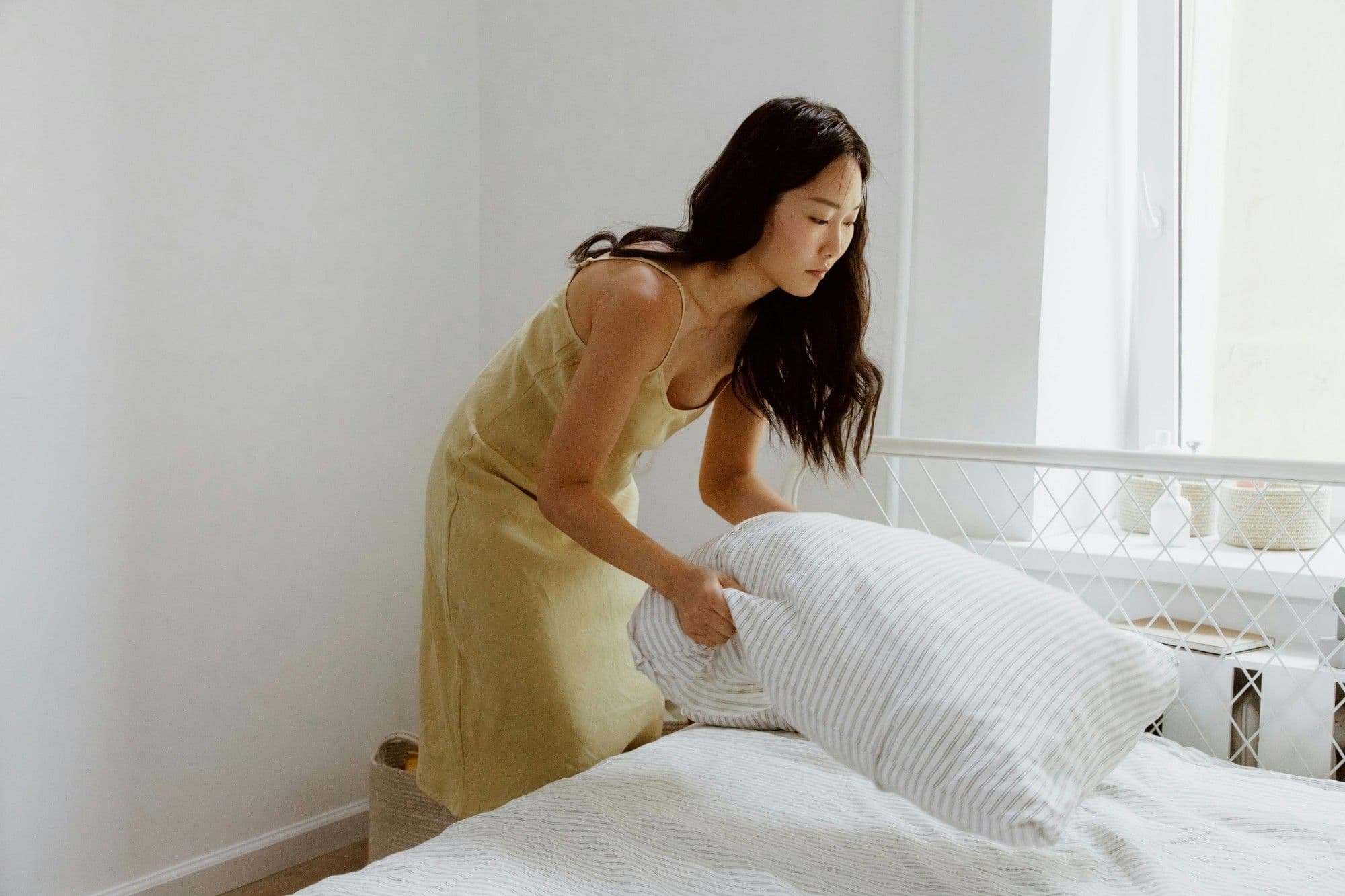
We'll spend hours picking out a couch or debating a rug, and far less time asking what's touching our skin, and what we're inhaling, while we sleep. This guide walks through it category by category: what's worth buying, what to check on the label, what to skip regardless of how it's marketed, followed by the products we've vetted in each one.
Where You Restore
"Sleep is the golden chain that ties health and our bodies together." — Thomas Dekker
A third of your life happens in this room. The mattress off-gasses for years. The sheets carry chemical finishing treatments that spend every night pressed against your skin. The pillow is the closest material to your face and airways for eight hours without interruption.
Sleep is not passive. It is the only window your body has to repair, restore, and recalibrate. What surrounds you in those hours either supports that work or quietly interferes with it.
This is where the body does its most sacred work.
None of this means every conventional product in your home is working against you. It simply means what rests closest to your body matters most, and your bedroom holds more of that closeness than almost anywhere else.
A nervous system that can't fall into that restorative window night after night isn't just losing sleep. It's often the earliest sign of a body that isn't regulating, which is exactly where the next guide in this series picks up.
Bed Frame
Wood furniture is often treated with formaldehyde-based glues and finishes, especially in pressed wood or particleboard frames, which makes the frame one of the more overlooked sources of indoor air exposure in the room. Solid wood is worth prioritizing whenever it fits your budget, and FSC certification is the marker to look for, since it confirms the wood came from a responsibly managed forest. GREENGUARD Gold certification is another strong signal specifically for furniture, since it tests for chemical emissions after assembly. The one thing to walk away from is a frame with a strong chemical smell straight out of the box. That smell is off-gassing, and it can linger for weeks.
Vetted Bed Frames:
Madera White Oak Bed Frame FSC®-Certified by Naturepedic
The City Bed Frame FSC®-Certified by Avocado
Mattress
You have no control over most of what you'll sleep on in your lifetime, which is exactly why this purchase is worth getting right. Look for GOTS certified organic cotton or wool as the outer layer, with natural latex at the core. GOLS certification is the latex equivalent of GOTS and tells you it's the real thing. OEKO-TEX Standard 100 certification is worth checking for too, since it tests the finished product for harmful substances. Steer clear of anything listing a "proprietary foam blend" with no further explanation, and skip chemical flame retardants entirely when a wool layer, which is naturally flame resistant, is available instead.
Vetted:
Simplicity Mattress by SavvyRest
The Main REM Mattress by Coyuchi
If a fully natural mattress isn't within reach right now, an organic cotton or wool mattress protector and topper is a meaningful, lower-cost place to start.
Vetted:
Organic Waterproof Mattress Protector by Avocado
Bedding
The fabric your skin meets for the longest stretch of any hours in your day deserves the most intention of anything in this room.
Sheets
GOTS certified organic cotton or linen is what to look for here, and the certification matters more than the word "organic" on its own, since that word alone isn't a regulated claim. Skip anything labeled "wrinkle free" or "easy care." That finish is almost always a formaldehyde-based resin treatment.
Vetted:
Signature Hemmed Sheet Set by Boll & Branch
Organic Print Percale Sheet Set by Coyuchi
Pillows
Natural latex, wool, or organic cotton fill hold up better than synthetic over time, and GOLS certification for latex or OEKO-TEX Standard 100 for anything not fully organic are the markers worth checking for. Memory foam pillows can off-gas noticeably when new, and conventional polyester fill is petroleum based. Both are worth passing on.
Vetted:
Down Pillow With Organic Cotton Fabric by Naturepedic
Organic Wool Pillow by SavvyRest
Duvet Insert
Down or wool fill wrapped in a GOTS certified organic cotton shell is the combination to look for, with the certification applying to the shell fabric specifically. Synthetic polyester fill is harder to keep clean long term and doesn't breathe the same way, so it's worth skipping here too.
Vetted:
Lightweight Down Duvet Insert by Coyuchi
Air Quality
Indoor air is typically more polluted than outdoor air, and this is the room you're breathing in longest, six to nine hours at a stretch, every night. A true HEPA air purifier sized correctly for your room's square footage is worth prioritizing, along with a CADR rating that actually matches your room size. Watch for "HEPA type" on packaging, a marketing workaround rather than the real certification, and skip an oversized unit you'll only run on low out of habit. A properly sized purifier on low is usually quieter and more effective than an oversized one you're avoiding running at full power.
The plug-in air freshener is worth removing entirely, along with scented candles made from paraffin wax. Both release a steady stream of synthetic fragrance and VOCs into the exact air you're breathing all night, which works against everything else in this section. If you want scent in the room, a beeswax or coconut wax candle with a cotton wick, used occasionally rather than left burning, is the better trade.
A snake plant or pothos is a simple, low-maintenance complement here, not a substitute for the purifier. Both have been shown to help with indoor air quality and ask almost nothing of you in return.
Vetted:
Jaspr Air Scrubber - use code SACREDLEE for $200 OFF
The Rug You Step Onto
This one gets its own category, because it's the first surface your bare feet touch every morning and the last one they touch every night. A cheap synthetic rug, the kind that's easy to find affordably at a big-box home store, is almost always polypropylene or polyester, and it sheds microfibers with every step, right at the height where you're breathing while you dress and undress. It's an easy purchase to make without thinking twice, and it's also one of the more overlooked exposures in this room.
A small wool runner on each side of the bed costs more upfront, but wool doesn't shed microplastics, resists odor and moisture on its own, and holds up for years rather than seasons. You don't need to rug the whole room. Two small runners, one on each side, cover the spot that actually matters.
Vetted:
Handknotted Wool Rug by Coyuchi
Lighting
Rarely on anyone's non-toxic checklist, but it earns a place here for two reasons: material and melatonin. A solid wood, ceramic, or metal lamp base with a twisted cotton cord, paired with a warm 2700K bulb, addresses both at once. Vinyl or PVC-coated cords are worth avoiding, along with cool white or blue-toned bulbs in the evening, which work against your body's natural wind-down.
A Realistic Way to Set Up Your Bedroom
You don't need to replace everything in this room at once. Start with sheets and pillows, since those touch your skin most directly, then work outward toward the mattress, frame, and air quality pieces as they naturally wear out or as your budget allows. This is a foundation you build over time, not a checklist to finish this weekend.
Frequently Asked Questions
What should I prioritize first if my budget is limited? Sheets and pillows. Both touch your skin directly for hours every night, and both are more affordable than a mattress or frame replacement.
Is a fully natural mattress worth the investment? It's one of the more meaningful upgrades in the room given how much time you spend in direct contact with it. If it's not accessible right now, a mattress protector and topper is a reasonable place to start instead.
Do I need an air purifier in every bedroom? Not necessarily. It's worth considering if you deal with seasonal allergies, live somewhere with higher outdoor pollution, or you're making several other swaps at once and want help clearing lingering off-gassing while things settle.
Is the rug under my bed really worth swapping? More than most people expect. It's a small, one-time purchase that sits exactly where you breathe deepest and stand barefoot twice a day, which makes it a higher-impact swap than its size suggests.
What's the one certification I should look for across every category? GOTS for anything cotton-based, and OEKO-TEX Standard 100 as the baseline for finished textiles. Those two cover most of what matters in this room.
What rests closest to your body matters most, and for a third of your life, that's this room. Start with your sheets. Shop the For Sleep collection for every product in this guide.